

ESMS on Renewable Energy Program – Solar

ESMS on Renewable Energy Program – Solar
I. PROGRAM DESCRIPTION
This program includes the financing of a 10MW plant in Mongolia. Although this funding proposal currently includes a single project, the proposal is being submitted as a program to the GCF because XacBank plans to submit additional solar projects in upcoming proposals, and together, these sub-projects will comprise XacBank’s Renewable Energy Program.
As part of Mongolia’s Intended Nationally Determined Contributions (INDC), the country aims to supply 20% of the country’s energy through renewable energy by 2020, and 30% by 2030.
Utility-scale SPP projects like the one here proposed are new in Mongolia. Currently, there exists only one, a 10 MW SPP in Darkhan city, which became operational in December, 2016.
Summary of Key Project Information
II. ENVIRONMENT AND SOCIAL MANAGEMENT SYSTEM (ESMS)
The program’s environmental and social management system (ESMS) has been devised in accordance with the Environmental and Social Standards of XacBank, as a GCF-accredited entity, and consistent with the GCF environmental and social safeguards (ESS) standards. The main purpose of this ESMS is to describe the mechanisms by which XacBank will require and ensure that the environmental and social risks and impacts will be continually screened and assessed and that the environmental and social management plan describing how the adverse environmental and social risks and impacts will be avoided, mitigated, and managed by the implementing entity.
At the time of program development, the specific locations of the projects and the types of technologies to be used for the projects have been made clear already. Also, the relevant land, project, and construction permits and right s have been acquired. The project owner has submitted a fully approved (by the Ministry of Environment) Environmental and Social Impact Assessment (ESIA), as well as an Environmental Management Plan (EMP). The ESMS therefore will:
The guidelines and processes will be institutionalized in the program and enforced through implementation underpinned by the contractual provisions agreed with the subproject proponents. The program’s guidelines, procedures and mitigation requirements are in line with the requirements of the GCF and XacBank.
III. SUB-LOAN TYPE AND POTENTIAL ENVIRONMENTAL AND SOCIAL RISKS AND IMPACTS
The program will co-finance the construction and operationalization of a solar power plant in Mongolia. This project could potentially pose environmental and social risks and have potential for adverse impacts to the communities and the environment. Avoiding and mitigating these risks and potential impacts are fundamental to the operations at the subproject and program levels.
Within XacBank’s Social and Environmental Management System (SEMS), all projects/programs are categorized prior to the loan approval based on potential risks associated with it as screened using XacBank’s risk screening procedure. In short, XacBank’s social and environmental risk screening process for this program is the same as is used for all loans issued by the bank. The process includes checking the sub-project’s proposed activities against an Environmental and Social Risk Screen Tool (Annex 1) and supplementing to ensure the activity is not within a list of prohibited activities (Annex 3).
All supported subprojects will be screened for their potential environmental and social impacts. The subprojects under this renewable energy program might cause some level of environmental and social impacts that would fall under Category B[1]. For Category B, the GCF and XacBank program requires the subproject proponent to carry out a limited focus Environmental and Social Impact Assessment or other appropriate environmental and social assessments that would also include management plans to avoid and mitigate the potential environmental and social impacts.
[1] The Green Climate Fund has adopted the Performance Standards of the IFC, including its project categorization.
The program does not include any high-risk, Category A, subprojects where the environmental risks and impacts may be significant, unprecedented, and irreversible. None of the subprojects will be located in protected and/or critical habitats or culturally or socially sensitive areas and require massive displacement of communities including vulnerable population.
IV. ESS POLICY BACKGROUND
XacBank background
XacBank has a comprehensive SEMS in place already, based on its established Social and Environmental Management System, and will apply it to the MSME program. This ensures that sub-projects financed through the program will comply fully with all requirements needed to ensure prevention and mitigation of environmental and social risks related to the implementation of these projects. XacBank will also define roles and responsibility for designated staff members for the oversight and on-going implementation of our SEMS. XacBank’s SEMS was internally adopted in 2002, with revisions made in 2008, 2011, and 2014, all of which were approved by XacBank’s Board of Directors.
The Bank is strongly committed to the principles of sustainable development as exemplified by the implementation of its ISO 14001-compliant Social and Environmental Management System (SEMS) to address environmental issues, both social and ecological, arising from the Bank’s operations since 2002. The Bank firmly believes that sustainable development can only come from educated and skilled people and businesses concerned equally about the Planet, People and Profit (3Ps). All employees related to the loan process and other processes, such as Procurement, receive regular trainings and workshops in applying E&S principles and procedures.
Also taken into consideration are the sub-borrower’s employee work place safety, health and hygiene practices and whether or not they cause any adverse effect to the local areas and community. Furthermore, all sub-projects financed by the Bank must comply with the Bank’s SEMS List of Excluded Activities (annex 3) and Mongolia’s national environmental, health, safety and labor regulations and standards (for health, safety, and labor regulations and standards, see the following report: http://www.ilo.org/wcmsp5/groups/public/---asia/---ro-bangkok/documents/policy/wcms_bk_pb_303_en.pdf ).
Mongolia’s Environmental Policies, Regulations, and National Priorities
The program is in line with a number of explicitly stated policy initiatives on the part of the Mongolian government. Mongolia has submitted an Intended National Determined Contribution (INDC). The program here proposed is in line with Mongolia’s INDC as it will directly contribute to the stated goal of increasing Mongolia’s renewable energy production share to 20% of total energy production by 2020, and 30% by 2030. The IRENA report writes “In parallel, Mongolia has stepped up efforts to improve the conditions for domestic development and deployment of renewables. The Renewable Energy Law, passed in 2007, has provided a fundamental legal basis to regulate the generation and supply of renewable power. Amid changing circumstances, parliament amended the law in June 2015. The improved legislation should strengthen public-private partnerships and create a market oriented framework for the energy sector.”
In October, 2012, Mongolia’s Parliament adopted the Law of Mongolia on Environmental Impact Assessment. The law requires that any proposed project that will have an impact on the environment must:
Financiers of projects are legally barred from providing financial assistance to projects which are harmful to environment, society and human health. The EIA law also requires that in preparing an EIA report, the project sponsor must include minutes of meetings at which local people who are to be affected by a proposed project were consulted.Annex 13 consists of a letter of confirmation which states that such meetings were held, and that the consultations with the stakeholders involved them giving their inputs on the project and its impacts on the environment and social situation. The detailed minutes have been archived by the Ministry of Environment.
The EIA Law authorizes the relevant minister to adopt detailed regulations on such public participation. However, the EIA law contains no objective criteria for what would be considered "harmful.” As such, the ESS policy for this program represents an extension and strengthening of this existing EIA law, with the addition of social elements. The program thus aligns with domestic INCD, NAMAs, and the Green Development Policy as well as the mission of the Green Climate Fund.
The Government of Mongolia requires that all ESIA’s conducted by an approved organization and approved by the Ministry of Environment must include (but are not limited to) the below sections:
The EIA law’s requirements have sections that cover the GCF interim ESS’s PS1, PS3, PS4, PS5, PS6, PS7 and PS8. As for PS2, Labour and working conditions, the only one not covered specifically in the EIA Law, is covered by XacBank’s Environmental and Social Risk Screening Tool, the SEMS List of Excluded Activities, the Social and Environmental Performance Report, as well as the detail ESIA provided by the subproject owner. These documents can be found in Annex 1, 3, 5, and 12, respectively.
V. ENVIRONMENTAL AND SOCIAL DUE DILIGENCE
Under its SEMS, XacBank screens and categorizes all projects into three categories:
| Category | Environment | Involuntary | Indigenous Peoples |
| A | A proposed project is classified as category A if it is likely to have significant adverse environmental impacts that are irreversible, diverse, or unprecedented. These impacts may affect an area larger than the sites or facilities subject to physical works. | A proposed project is classified as category A if it is likely to have significant involuntary resettlement impacts. The involuntary resettlement impacts of an supported project are considered significant if 200 or more persons will experience major impacts, which are defined as (i) being physically displaced from housing, or (ii) losing 10% or more of their productive assets (income generating). | A proposed project is classified as category A if it is likely to have significant impacts on Indigenous Peoples. The significance of impacts of an supported project on Indigenous Peoples is determined by assessing (i) the magnitude of impact in terms of (a) customary rights of use and access to land and natural resources; (b) socioeconomic status; (c) cultural and communal integrity; (d) health, education, livelihood, and social security status; and (e) the recognition of indigenous knowledge; and |
| B | A proposed project is classified as category B if its potential adverse environmental impacts are less adverse than those of category A projects. These impacts are site-specific, few if any of them are irreversible, and in most cases mitigation measures can be designed more | A proposed project is classified as category B if it includes involuntary resettlement impacts that are not deemed significant. | A proposed project is classified as category B if it is likely to have limited impacts on Indigenous Peoples. |
| C | A proposed project is classified as category C if it is likely to have minimal or no adverse | A proposed project is classified as category C if it has no involuntary resettlement impacts. | A proposed project is classified as category C if it is not expected to have impacts on Indigenous Peoples. |
If the sub-project is evaluated as Category A, then the project will not be accepted to be financed by the program. If the sub-project is in Category B, then the project will need to have an environmental and social impact assessment. In cases of sub-projects being evaluated in Category C, then the project will be subject to an environmental and social screening, using the checklist as outlined below.
Environmental and Social Responsibility Risk Evaluation
Risk evaluations are carried out for all Bank loans that are more than MNT 50,000,000 (approximately US$20,000) and have tenors more than 12 months based on a comprehensive scorecard that includes sections on environmental, social and labor, compliance, and local area and community issues. Each category is rated from 6 to 1, with 6 being the least risky and 1 being the most risky. The Bank is determined to demonstrate the utility of its SEMS to its stakeholders, including clients, and through stakeholder engagement, closely monitors the environmental and social performance of its borrowers and actively manages any instances of non-compliance to rectify such situations.
The sub-project under the renewable energy program will be evaluated on the environmental and social risks associated with it, and the Bank will consider a wide variety of factors, including, but not limited to, the following:
The environmental and social due diligence for PFI projects will start with questionnaires, which must be completed by the sub-project owners and submitted to the XacBank for review. Based on this information, XacBank will determine:
Environmental and Social Responsibility Risk Evaluation Form
XacBank has in place a comprehensive Social and Environmental Risk Evaluation checklist that it applies to any loan larger than 20,000USD. For this program, XacBank plans to utilize the same tried and tested evaluation method to all subprojects of the renewable energy program. Due Diligence on ESIA from Sub-project.
The Bank has received the ESIA from the sub-project under this program. Still, the Bank will conduct its own environmental and social safeguards (ESS) assessment during the loan proposal submission phase. It will be performed as part of the extensive list of required documents that need to be completed in order to enter the program loan proposal into the Bank’s Credit Committee. These documents include:
The ESIA reports have already been submitted to and approved by the Ministry of Environment as satisfying all requirements.
The Accredited Entity has reviewed the ESIA provided by the developer and provides the key summary of findings in the succeeding sections below:
a. Air Quality
Impact of the Project on air quality, its assessment
From the results of the analysis, the amount of dust emitted by the process of earth works related to construction is relatively low compared with other similar-scaled projects. Depending on the wind speed or climatic conditions, the spread of dust particles and pollutants in gas state shall cover 20-300 meters in distance, and be scattered on ecological level in 300 meters in distance. Dust and gas pollutants in the project area shall be classified as a modest risk. However, after completion of earth works and installation of equipment, impact on air quality will be reduced to zero impact level. As such, project operations have positive impact on air quality, while there is a minimum level of negative impact on air quality and no negative impacts from air quality on nearby population.
b. Ground Surface and Underground Soil
Impact of the Project on land surface and underground soil
A total of 26.4 ha of land shall be exploited during the implementation of the project. From this, 24.5 ha will be used for installation of solar displays, 0.8 ha for transmission and distribution substations, 0.06 ha – station control office, 0.0009 ha- for guard station, and remained 1.04 ha for other area and temporary waste disposal site. According to the plan, the project management office and guard station shall be constructed with the use of special isolation containers, thus no additional buildings shall be constructed. Solar display bases shall be installed in 1m depth, which means that only top layer of ground shall be subjected to project operations, and no destructive activities shall be conducted in depth. As such, the project operations have a positive impact on land surface. Negative impact on land surface is low. After completion of the project, there will be no additional land use, and land use purpose will not be changed for any reason.
c. Surface and underground water
Surface water network
The project area has no surface water network.
Underground water
Underground water analysis conducted near the project area reveal that the water can be classified as pure and soft.
Impact of the project on surface and underground water, its assessment
Within the framework of the project, water shall be only used for drinking consumption of employees. During earthwork and project operation stages, drinking water for employees is planned to be transported from a water supply well from the center of the nearby soum (village center). The drinking water consumption of the employees is estimated to be 1.9 m2 per day, which does not have any negative impacts on the local water source.
d. Plant cover erosion and pollution level in project area
The planned project implementation area is located in a remote area, away from settled regions, thus there are no sources that may cause soil erosion.
e. Fauna
The area of the project implementation has steppe and grassland properties, and is referred to as the steppe and desert region according to fauna zonation. The area is dominated by animals that are only adaptable to the steppe region, such as field mice, gerbils, antelopes, foxes, etc.
f. Socioeconomic factors
The project shall have a positive impact on the socioeconomic situation of the project area, as it will create large, long term benefits in terms of production of energy with minimum impact on the environment, solving the deficiency of power, creating new jobs and reducing unemployment, and increasing taxes to be paid to the local budget.
g. Project risk assessment, management
Toxic and hazardous chemicals
No activities associated with the use of toxic and hazardous chemicals shall be conducted throughout the SPP project implementation period.
Potential accident and incidents
In the case of any accidents during the implementation period, there is a high risk of spreading technological raw materials, wastes and pollutants in the air and atmosphere, causing enormous damage to environment. Therefore it is inevitably required to investigate risks of potential accidents. Potential accidents may be cause by either of technical reasons, human factor, or natural disaster. Therefore, it is highly required to strictly and obligatorily comply with OHS rules, standards and constantly take preventive measures.
h. Conclusion on the ESIA
In general, negative impacts from project operations on the environment and human health has been estimated at a low level, an assessment which is consistent with the AE’s own evaluation. Additionally, if the mitigating measures that are recommended in the ESIA are completely executed, the potential negative impacts of the project can be completely eliminated.
VI. ESMS IMPLEMENTATION ROLES
The SEMS will be implemented by the relevant departments of the Bank. Individual sub-project screening will be done by the relevant particular loan officer. SEMS evaluations will be done through the Bank’s Compliance Unit. The sub-project implementer will also submit on-going, periodic reports to the Bank. Monitoring and reporting thereafter will be handled by the Eco Banking Department. For more on the internal roles for this process within XacBank and the obligations of each party and institution, see the below organigram.
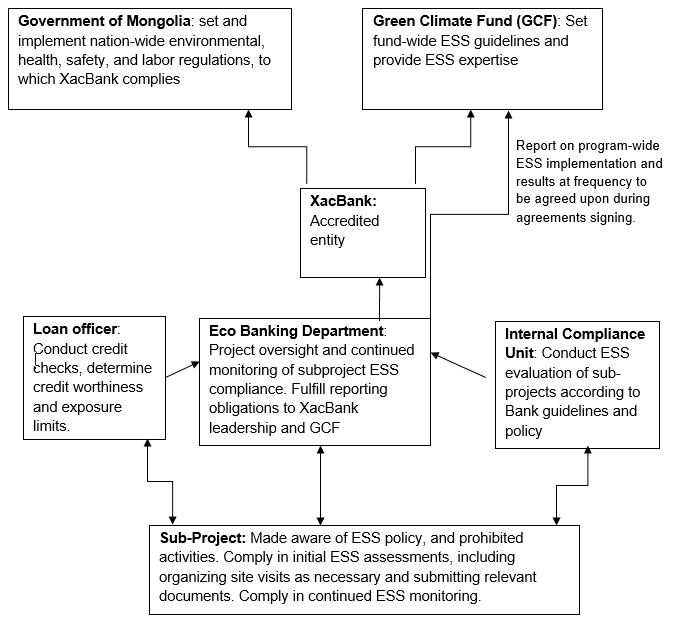
Institutional Arrangement for Implementation
XacBank (AE) will be the executing entity of this program. Sub-loans will be distributed through XacBank’s Head Office, Corporate Banking Division, upon receiving the facility from the GCF. The process of distributing Eco Business loans follows normal bank disbursal procedures with additional steps to ensure the 20% CO2 reduction is achieved. These ESS-relevant steps are as follows:
The Social and Environmental Manager, and the Legal and Compliance Officer will act on a full-time basis to coordinate and monitor implementation of the Bank’s Social and Environmental Policy. The Bank’s Compliance Officer will compile and report on reviews of the Bank’s social and environmental compliance to the Social and Environmental Manager. Management of the Bank will promptly notify the Shareholders if they are replaced, or if any changes are made in these positions or their main responsibilities.
Prior to disbursal of the loan proceeds, the relevant credit officer from the Corporate Banking Division will make an evaluation as to whether the loan would contravene the Bank’s Excluded Activities in appendix 3. This will be done through the process of discussion on relevant exclusions with that particular client.
The sub-projects of the Renewable Energy Program are required to abide by applicable environmental, occupational, health and safety requirements, and labor laws, rules and regulations, including prohibition of child and forced labor.
The Bank will also comply with all applicable environmental and social policies, covenants and guidelines of its holding company’s Shareholders. In addition, for loans considered by reasonable judgment to have a potentially significant and irreversibly damaging environmental impact, the Bank will obtain written confirmation from relevant Shareholder or other Investor that such projects comply with local regulations and applicable their environmental and social policies. Examples of such projects are listed in Appendix B. The Social and Environmental Coordinator will be responsible for obtaining assurance that a prospective sub-project is not engaged in prohibited activity and is in compliance with the Bank’s social and environmental management policy.
VII. STAKEHOLDER ENGAGEMENT PROCESS
XacBank has well-established processes for engagement with relevant stakeholders as well as civil authorities so as to ensure ownership and ESS compliance. Overall, throughout the development of the projects, its funding proposal and this ESMS, many types of consultations were done, comprising meetings, telephone conversations and E-mail correspondences with the project developers, related stakeholders, the NDA of Mongolia, various NGO’s, and more. Since the inception of the solar power plant projects, XacBank has conducted upwards of 6 meetings with the project owners, 2 with the NDA, exchanged more than 200 emails and had dozens of telephone consultations.
Gender-sensitive stakeholder engagement
As Mongolia’s renewable energy sector, particularly solar power sector, is in its nascent stages, it is increasingly important that women from both a client and a partner side are consulted in decision-making and program design. In this way, the social risks of gender-exclusion based upon program design or program implementation will be limited. In 2014, XacBank ran a focus group with women-led SMEs to understand their specific financing needs. The results of this study were used in the design of the program. Finally, XacBank has utilized the GCF’s gender resources and expertise through consultative meeting and the development of a strong Gender Action Plan, whose implementation will limit ESS-related risks.
VIII. GRIEVANCE REDRESS MECHANISM (GRM)
Program level
Grievances from stakeholders and potential affected communities and households are received by the Bank through dedicated channels, including a dedicated phone line (1800-1888), 24-hour online chat system, and an email address (https://www.xacbank.mn/mn/home/chatOption). The GRM will not preclude or impede access to the judicial or administrative remedies, and XacBank will appropriately inform each sub-project and its affected stakeholders of the GRM during the engagement process.
After receipt of any complaints, they are to be handled in accordance with the Bank’s internal policies and procedures, including, but not limited to, the Investigation Procedure, which outlines step-by-step the process of receiving grievances, categorizing them, investigating the case, complaint resolving, dispute settlement, and the appropriate corrective actions to be taken.
Sub-project level
The GRM will be scaled to the risks and adverse impacts of the sub-projects and will be elaborated in the environmental assessment and evaluation of each individual sub-project. The GRM will be discussed during consultations with sub-project owners and its affected stakeholders to ensure it is both fit for purpose and appropriate to the social and cultural context of the project level.
All grievances received by XacBank regarding any sub-projects under the renewable energy program will be entered into a register with the date, name, contact details and the reason for the complaint. A duplicate copy will be made and given to the complainant for the record at the time of registering the complaint. Minor complaints, which can be resolved quite easily and acted upon immediately, can be addressed at the sub-project level by the sub-project owner and/or the Bank, if necessary. Where the complaint is of a more serious nature, the sub-project owner and/or the Bank has up to 20 business days to resolve the complaint.
There will be no costs associated with making any complaints. Should the complainant not be satisfied with the measures taken to address their grievance, they may, at their discretion, go through the appropriate channels to pursue further action, at the complainants’ own cost. If requested, the complainant has the right to their anonymity. The resolution of complaints will be handled in a fair, transparent and inclusive manner and will be guided by stakeholder engagement and dialogue. After the complaint has been resolved, the situation will be continually monitored to ensure that the same issues will not arise again.
The Bank will keep a register of all received complains along with their status and will ensure that they are resolved.
Project-related grievances may be filed by any affected party through the Grievance Redress Mechanism (GRM) found here. Grievances will be handled in accordance with the bank’s procedure on receiving and resolving complaints and feedback which may be consulted here. Grievances related to the programme may also be filed to the GCF directly through their Independent Redress Mechanism (IRM) at https://irm.greenclimate.fund/.
IX. MONITORING ARRANGEMENTS
All sub-borrowers will be required by the Bank to submit environmental and social reports on an annual basis according to the format provided by the Bank. The format will integrate the Environmental and Social Responsibility Risk Evaluation (Annex 1), which is a comprehensive assessment comprising environmental, social, labor, compliance, and local area and community issues. The Bank reserves the right to conduct site visits to financed sub-projects to monitor the implementation of the Bank’s requirements as necessary.
[1] The Green Climate Fund has adopted the Performance Standards of the IFC, including its project categorization.
Annex 3 (appendix A in XacBank SEMS Policy): SEMS List of Excluded Activities
NOTE: A reasonableness test will be applied when the activities of the project would have a significant development impact but circumstances of the country’s region or local area may require adjustment to the Bank’s List of Excluded Activities.


